Exams and X-rays
Dental Exams
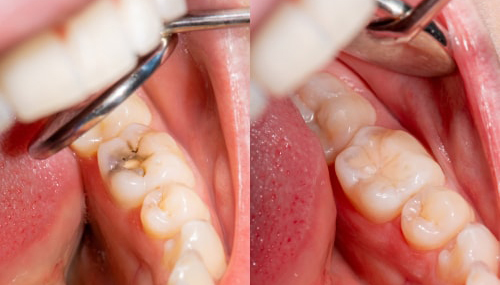
At Delmarva Dental Services, we strive to provide exams that are both comfortable and convenient. Routine evaluations are essential to maintaining good oral health, so our dentists recommend that patients visit us at least twice per year for check-ups. These oral health exams can also be accompanied by a professional teeth cleaning, which can reduce plaque and tartar and give special attention to hard-to-reach areas. In addition, dental cleanings can give the teeth a more polished, refreshed appearance. An oral cancer screening can also be included in your regular oral exam to identify any tissue irregularities in their earliest stages.
Regular exams enable us to provide a precise diagnosis on the state of your oral health. If we see any potential concerns, we will talk with you about treatment options and create a personalized plan to address those issues and to help prevent major dental complications in the future.
Dental X-rays
Radiation Exposure Radiographs (X-rays) have a huge impact upon our lives, from airport scanners to cancer treatment, but in many ways they are a mystery to most people. X-rays have always been present but weren’t discovered until 1895 by Wilhelm Roentgen. Since that time they have been used for diagnosis and treatment of injury and disease.
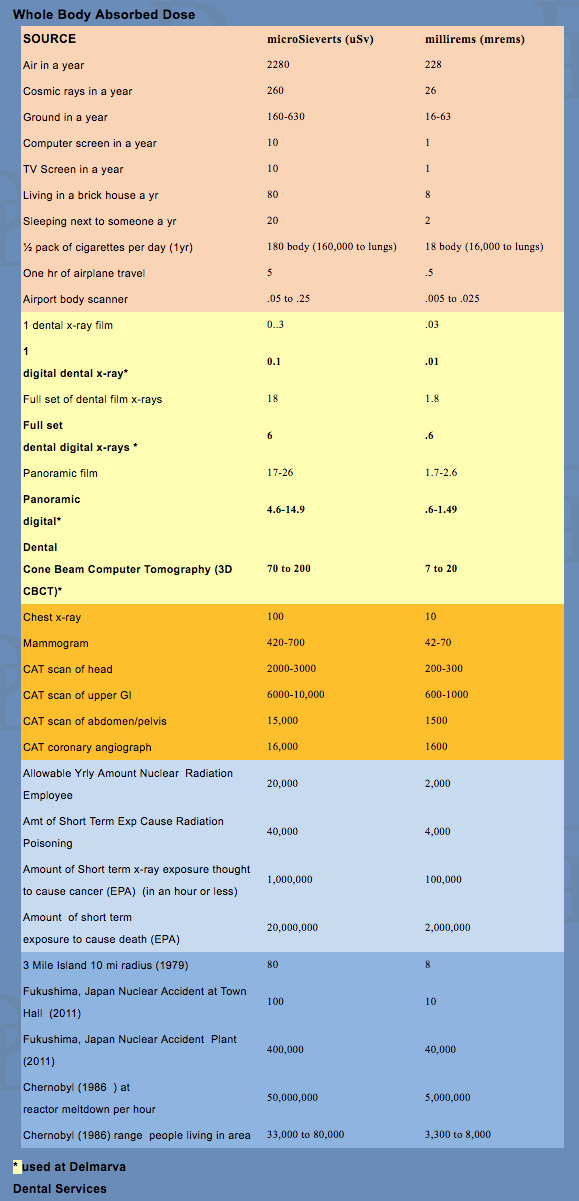
An x-ray is a wave of electromagnetic energy. There are two types of electromagnetic energy (waves): non-ionizing (low frequency) and ionizing (high frequency) energy. Examples of non-ionizing waves are UV light, visible light, microwaves, and radio waves. X-rays are ionizing radiation, which can damage cells, including the DNA, by removing an electron (ionizing) from the atoms in molecules. The higher the x-ray dose the greater the damage. Low doses spread out over time are thought to be harmless because the body repairs any damage. However, we know high doses cause cancer from studies of atom bomb survivors in Japan. Radiation doses can be measured in many ways. The more common way to measure is the biological effect on the body. The older unit of measure was the Rem and millirem. The newer international measure is the Sievert, millisievert, or microsievert. The measurements are similar to the meter and millimeter for distance. Different parts of the body absorb radiation, and therefore are affected differently by it. The salivary glands are more affected by an x-ray scan of the head than the jaw bone. Parts of the body that grow faster are affected more than slower-growing areas. Cancer cells grow very fast and are more affected by radiation. This is why radiation is used to treat cancer tumors. The whole body absorbed doses listed in this table are an average of all the body parts. Ionizing radiation (x-rays) can come from many sources, such as cosmic radiation from our solar system, radioactive elements in the soil, and radon from the air. The average person receives about 620 millirems (6,200uSv) per year, half from the environment and half from medical procedures. The table shows the amount of radiation received to the whole body from various x-rays sources.
Two very important computer enhanced developments have lessened the effect of x-rays to our bodies. The first is the use of digital sensors rather than film. Digital sensors are more sensitive than film and much less radiation is needed. For example dental film x-ray exposure is three times digital x-ray. The second development is the ability to focus the x-ray beam in a more precise way, which concentrates the radiation to the smaller area of interest. This minimizes the effect of the radiation to the body. For example, a medical CAT scan of the head is 10 times more radiation than a “cone beam computerized tomograph“ (CBCT) of the head. Highly focused radiation is also used for cancer radiation treatment.
Delmarva Dental Services takes its responsibility to your health seriously. We will be more than happy to discuss the risks versus the benefits of any diagnostic or treatment procedure.
3D X-Rays
Delmarva Dental Services is excited about our 3D dental scanner. Cone beam computerized tomography (CBCT), or “3D” for short, is a refinement to the computerized assisted tomography (CAT scan) used in medicine. The main difference is that the dental 3D CBCT is a highly-focused beam to a small area, which drastically reduces the radiation exposure. (See “X-Ray Exposure, “Radiation Table”). It is an important tool in dentistry because it shows teeth and jaws in 3 dimensions instead of the typical 2 dimensions. It can show the actual size of roots on teeth to be extracted, proximity of roots to the maxillary sinus, bone width prior to implant placement, and abscesses on teeth that don’t appear on conventional x-rays. There is also a program that can show a 3-dimensional model of the scanned area. We can virtually place dental implants in the 3D model and make surgical guides prior to implant placement. This makes implant procedures more predictable, more accurate, less timely, less invasive, less uncomfortable, and more successful.
DO DENTAL X-RAYS CAUSE BRAIN CANCER?
Dr. Elizabeth B. Claus, an epidemiologist at the Yale School of Medicine in New Haven, Connecticut and at Brigham and Women’s Hospital in Boston, led a study published in a journal entitled “Cancer” (April 2012) suggesting an association between mouth x-rays and tumors called meningiomas. The tumors, which take their name because they arise in the meninges (the membrane surrounding the brain and spinal cord) account for about a third of brain tumors detected in the United States. Although they’re most often benign and slow-growing, they can cause disability by exerting pressure on the brain. Claus and her research colleagues reviewed histories of dental x-rays among 1,433 patients diagnosed with meningiomas between the ages of 20 and 79 in 2006-2011 and compared them with dental x-ray histories of healthy subjects matched for age, gender, and geography. All were asked to recall from memory all dental x-rays they’d ever received. What the Yale study found was that people who developed the tumors were more than twice as likely as those in the control group to report having received bitewing x-rays at least yearly. The study’s authors’ conclusion states: “Exposure to some dental x-rays performed in the past, when radiation exposure was greater than in the current era, appears to be associated with an increased risk of intracranial meningioma. As with all sources of artificial ionizing radiation, considered use of this modifiable risk factor may be of benefit to patients”. Cancer 2012. © 2012 American Cancer Society.
The study relied on the subjects’ memory of how many x-rays they had many years ago and this type of self-reporting data is usually inaccurate. The study does not prove that dental x-rays cause these tumors; much more research would be needed to determine that. And experts say the finding does not change the recommendation to have x-rays only when necessary. Otis W. Brawley, M.D., chief medical officer of the American Cancer Society said, “We need more data before we can even begin to state there is a relationship between dental x-rays and these tumors. Until that research is done, the best advice we can give people is to get dental x-rays when they are necessary and only when they are necessary.” Delmarva Dental Services uses digital x-rays, which are ¼ the dose of the radiation dose in this study. (See “X-ray Exposure” on this table) After reviewing the new research, the American Dental Association issued a statement reiterating its longstanding position that dentists should order dental x-rays “only when necessary for diagnosis and treatment. Since 1989, the ADA has published recommendations to help dentists ensure that radiation exposure is as low as reasonably achievable,” the ADA said in the statement, released to coincide with the online publication of the new study in Cancer, the journal of the American Cancer Society. The ADA currently recommends x-rays every 1-2 years for healthy children and every 2-3 years for healthy adults.